

Table of Contents
- What Is a 360° Digital Marketing Strategy?
- Why Startups in India Need 360° Digital Marketing
- Core Marketing Elements Explained in Detail
- 1. SEO: Building a Discoverable and Scalable Digital Presence
- 2. PPC Advertising: Targeted, Measurable, and Conversion-Driven
- 3. Social Media Strategy: Multi-Channel Engagement for Growth
- 4. Content Marketing: Authority, Relevance & Contextual Impact
- 5. Analytics, Monitoring & Continuous Optimization
- 6. Customer Experience & Retention: The Often-Ignored Powerhouse
- Final Word
- FAQs
Our Services


Categories
- AI Optimization
- Blog Optimization
- Case Study
- Conversion Rate Optimization
- Digital Marketing
- Digital marketing agency
- Digital marketing company
- Digital Marketing Consultant
- digital marketing for manufacturers
- Email Marketing
- Google Ads
- Google Adwords
- Influencer Marketing
- Infographics
- Local Listing
- Local SEO
- Manufacturing
- On-Page SEO
- PPC
- Reputation Management
- Restaurant
- Sales Automation
- SEO
- SEO Services
- SEO Tools
- Social Media Marketing
- Technical SEO
- Technology
- Web Design
Startups don’t get the luxury of “trial and error marketing.”
You need traction, trust, and real results without burning through runway.
Currently, we’re in the era of 360-degree digital marketing. That means every channel: search, social, email, ads, all of it works together like one well-oiled growth machine. Not a bunch of random tactics fighting for attention.
Consider this: there are more than 4.6 billion people online, and India is rapidly emerging as a significant digital market. Your audience is out there, always searching, scrolling, comparing, and making decisions. If your brand only pops up here and there, you’re basically invisible.
A real 360° digital marketing strategy from a full-service digital marketing agency in Ahmedabad can put your brand wherever your audience looks.
Let’s see how 360° Digital Marketing can deliver a consistent message that builds credibility and drives conversions.
What Is a 360° Digital Marketing Strategy?
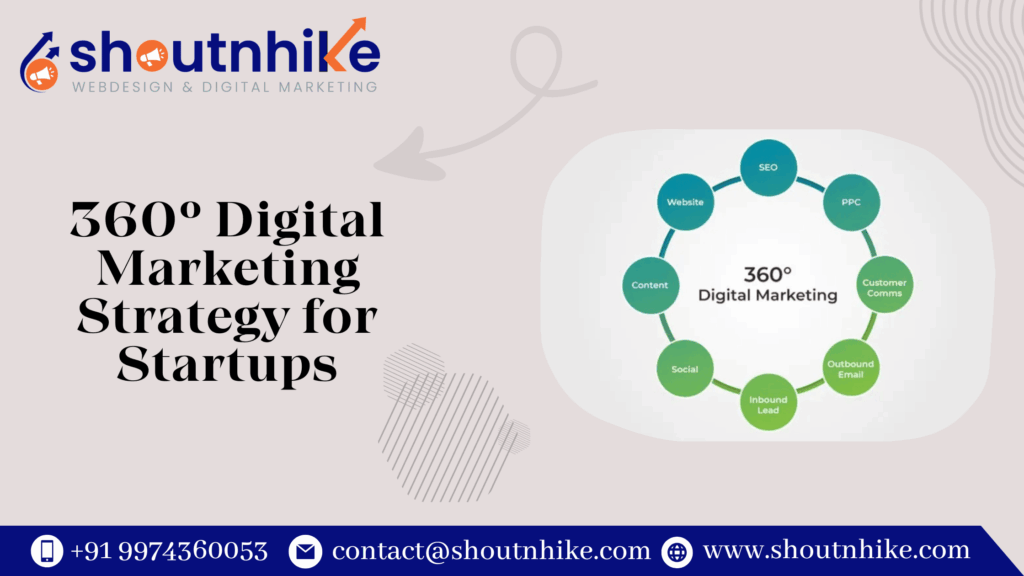
A 360° strategy means your brand speaks with one clear voice across every digital touchpoint, such as search engines, social platforms, email inboxes, paid ads, landing pages, and customer support.
Instead of isolated campaigns, everything works together:
- SEO brings organic visibility
- PPC generates immediate leads
- Content builds authority
- Social media drives engagement
- Email nurtures prospects
- Analytics measures performance
This is exactly how people move online now. Someone might see you on Instagram, look you up on Google, read your latest blog post, get hit with a retargeting ad, and finally convert through an email offer. A fragmented strategy loses this journey. But with a 360° digital marketing approach, you guide them every step of the way.
Why Startups in India Need 360° Digital Marketing
India’s got more than 850 million internet users, and digital habits are spreading fast, even in smaller towns and cities. With increasing competition in SaaS, eCommerce, D2C, education, fintech, and service sectors, startups must build trust quickly. That’s just the reality with so much competition.
Benefits include:
- Faster brand recognition
- Higher conversion rates
- Improved ROI through data tracking
- Stronger customer retention
- Scalable marketing systems
So, instead of just trying random tactics and hoping something sticks, smart startups focus on building a solid, organized marketing ecosystem from the start. That’s how they stand out.
Core Marketing Elements Explained in Detail
1. SEO: Building a Discoverable and Scalable Digital Presence
SEO is the backbone of organic visibility. For startups, a strong 360° strategy covers a lot more than keywords. It combines technical optimization, content alignment, and search intent analysis.
It includes:
- Technical SEO Framework:
Startups must ensure their website is crawlable and indexable with clean URL structures, XML sitemaps, robots.txt accuracy, schema markup, and lightning-fast load speeds, which comply with Core Web Vitals requirements.
- Search Intent-Based Content:
Every page should answer specific queries users are actively searching for, like transactional, informational, navigational, and comparison intent.
- Authority Building through Quality Links:
The process of backlink acquisition through PR outreach, guest posting, and authoritative content development leads to enhanced domain credibility, which improves ranking opportunities.
- Local SEO (Critical for Early-Stage Startups):
Optimized Google Business Profiles and local citations, together with geo-based keywords, provide visibility for users in specific regions.
The combination of these elements not only enhances ranking performance but also enables discoverabilityby target audiences who have the potential to convert.
2. PPC Advertising: Targeted, Measurable, and Conversion-Driven
PPC functions as the primary performance-based component of a complete 360° approach, which provides immediate visibility and precise targeting capabilities, while delivering measurable return on investment.
- Advanced Audience Targeting:
Google Ads and Meta Ads platforms permit advertisers to select target audiences based on demographic information, interest patterns, user behavior, device preferences, and actual buying behavior.
- Bid Strategies & Budget Allocation:
Startups can scientifically manage their advertising budget through automated bidding methods, which include Target CPA, Max Conversions, and Target ROAS.
- A/B Testing & Real-Time Optimisation:
The team conducts ongoing tests of various elements, including headlines, creatives, landing pages, and CTA buttons, to maintain profitable campaign results.
- Conversion Tracking & Analytics:
GA4 and UTM parameters and Meta Pixel technology track events, which include form submissions, calls, add-to-cart actions, and purchases to provide accurate ROI evaluation.
Startups include PPC to generate instant leads, test messaging quickly, and scale what works. This makes PPC essential for early traction. Partnering with a full service digital marketing agency in India can further accelerate this process by ensuring expert campaign setup that aligns perfectly with a startup’s growth goals.
3. Social Media Strategy: Multi-Channel Engagement for Growth
Social media serves as a crucial element of the 360° approach because it achieves more than basic photo sharing and like-gathering activities. Startups use it to engage customers and obtain their feedback while transforming leads into actual sales.
Main Components:
- Platform-Specific Content Mapping:
Instagram → Visual storytelling, reels, brand identity
LinkedIn → B2B credibility, thought leadership
Facebook → Community building, targeted ads
X (Twitter) → Real-time engagement & updates
- Social Listening Tools:
The tools like Brandwatch and Sprout Social enable users to monitor brand mentions, sentiment analysis, and competitor activities.
- Retargeting & Lookalike Audiences:
Social platforms track user behavior and show tailored ads to users who previously engaged with your content or website.
- Creator and Influencer Collaborations:
Startups use micro-influencers to connect with specific audiences because these influencers deliver genuine brand messages to their followers.
Social media functions as a relationship-building engine that businesses should use to establish connections with their customers.
4. Content Marketing: Authority, Relevance & Contextual Impact
The content provides fuel for search engine optimization, creates authority through expertise, and increases user interaction across various platforms. All content in a 360° ecosystem must match both audience expectations and platform behavior.
Pic Ref.
What will work:
- Content Funnel Structure:
TOFU (Awareness): Blogs, reels, infographics, educational posts
MOFU (Evaluation): Case studies, email sequences, comparison guides
BOFU (Conversion): Landing pages, product demos, testimonials
- Contextual Content Deployment:
A carousel may work on Instagram, but a whitepaper fits LinkedIn. Content needs to match platform execution, as it determines the success of the content.
- Semantic SEO & Topic Clusters:
The process of interlinking related content helps to improve search authority while enabling Google to comprehend your total expertise.
- Video Content Dominance:
The establishment of brand identity through tutorials, explainer videos, behind-the-scenes content, and founder-led discussions.
Strong content transforms the brand from “just another startup” into a trusted, expert-driven voice.
5. Analytics, Monitoring & Continuous Optimization
Measurement remains crucial for every digital strategy because it needs continuous measurement for success. A 360° digital marketing strategy thrives on data-backed decisions.
Key Components:
- KPI Tracking Across Channels:
- Organic traffic
- CTR & Conversion Rate
- Bounce rate
- Cost per lead (CPL)
- Customer acquisition cost (CAC)
- Customer lifetime value (CLV)
- Behavior Analysis Tools:
The tools, like Heatmaps from Hotjar and Crazy Egg, show how users interact with your website.
- Cross-Channel Attribution Models:
The method helps you understand how much each channel contributes to conversion through first click, last click, linear time-decay, and data-driven attribution.
- Iterative Optimization:
The team establishes regular SEO enhancements together with ad targeting modifications and content updates based on performance metrics.
The startup operates through a continuous loop, ensuring established data-based methods instead of working on assumptions.
6. Customer Experience & Retention: The Often-Ignored Powerhouse
A complete 360-degree digital marketing approach operates beyond the point of conversion. It extends into the period of post-purchase customer interaction.
It includes:
- Email Automation Workflows:
The system includes welcome sequences, abandoned cart emails, re-engagement campaigns, and cross-sell journeys.
- CRM Systems Integration:
The software tools HubSpot, Zoho, and Salesforce enable users to handle lead management while monitoring customer interactions and customizing their communication process.
- Retention Metrics:
The repeat purchase rate
The churn rate
The customer satisfaction score CSAT
The net promoter score NPS
- Omnichannel Touchpoints:
Consistent experience across website, app, email, social media channels, and customer support services.
Retention establishes permanent business success by enhancing lifetime value and reducing acquisition dependence.
Final Word
The current digital landscape requires organizations to adopt unified strategies. A 360° digital marketing strategy connects all elements of SEO, PPC, content, social media analytics, and customer experience into a single system that drives business growth.
In essence, it helps startups:
- Show up where customers search
- Speak where customers engage
- Convert where customers act
- Retain where customers return
It’s a system built not for short-term spikes; it offers continuous, sustainable, compounding growth.
If you’re willing to take your startup to the level of “ Renowned Brand,” consult ShoutNHike today. Our full service digital marketing agency in Indiacreates complete 360° marketing strategies for startups that focus on performance.
👉 If you’re searching for 360-degree digital marketing services that drive measurable growth, let’s build a strategy that turns clicks into customers and startups into brands.
FAQs
1. How long does it take to see results from a 360° strategy?
PPC provides instant outcomes while SEO requires between three and six months to show results. Social and content strategies develop their effectiveness throughout their duration.
2. Is 360° marketing suitable for small startups with limited budgets?
Yes. A reliable full service digital marketing agency in India will create a strategy that allocates your budget effectively towards channels that deliver maximum results.
3. What industries benefit most from 360° marketing?
360° marketing proves beneficial for SaaS companies, eCommerce platforms, real estate firms, healthcare organizations, educational institutions, fintech companies, and local service providers.
4. Can startups manage 360° marketing internally?
Startups can handle 360° marketing tasks, but they face significant challenges. Partnering with experts enables companies to achieve better operational coordination, together with faster project completion and improved ROI.

Chirag Shah
CEO and Founder at Shoutnhike.com
I help client to grow business online with measurable result and swift ROI. I have 20+ years of Digital Marketing Industry experience and I have helped 2000+ business to grow online. I am Google Adwords and Analytics certified professional with practical expertise.
Category:
Digital Marketing
Tags:
Digital Marketing Strategy Startup Marketing
 Get a Free Digital Marketing Consultation Get a customised digital marketing strategy to increase your website traffic, leads, and sales.
4.7 Rating from 170+ Google Reviews
 Contact Info
-

Call us
 +91-9974360053
 +44-20709-60062
 +1-908-392-0348
-

Email us
contact@shoutnhike.com -

Skype
shahchiragg
We are Featured in
Digital branding and marketing services built with expert planning and creative execution, helping brands grow stronger in a competitive online industry.