
Table of Contents
- Can Rankings Stay Stable While Organic Traffic Drops?
- AI Overviews Are Taking More Informational Clicks
- Google AI Mode Is Changing How People Search
- Zero-Click Searches Are Becoming a Bigger SEO Challenge
- Your Organic CTR May Be the Real Problem
- Search Demand May Have Changed
- Search Intent May Have Shifted
- AI Platforms Are Becoming Another Discovery Channel
- How to Diagnose Your Traffic Drop
- How to Recover Traffic Without Chasing Rankings
- Rankings vs Traffic vs Revenue: What Should You Track?
- Final Thoughts
- FAQs
Our Services


Categories
- AI digital marketing agency
- AI Optimization
- Blog Optimization
- Case Study
- Conversion Rate Optimization
- Digital Marketing
- Digital marketing agency
- Digital marketing company
- Digital Marketing Consultant
- digital marketing for manufacturers
- Email Marketing
- Google Ads
- Google Adwords
- Influencer Marketing
- Infographics
- Local Listing
- Local SEO
- Manufacturing
- On-Page SEO
- PPC
- Reputation Management
- Restaurant
- Sales Automation
- SEO
- SEO Services
- SEO Tools
- Social Media Marketing
- Technical SEO
- Technology
- Web Design
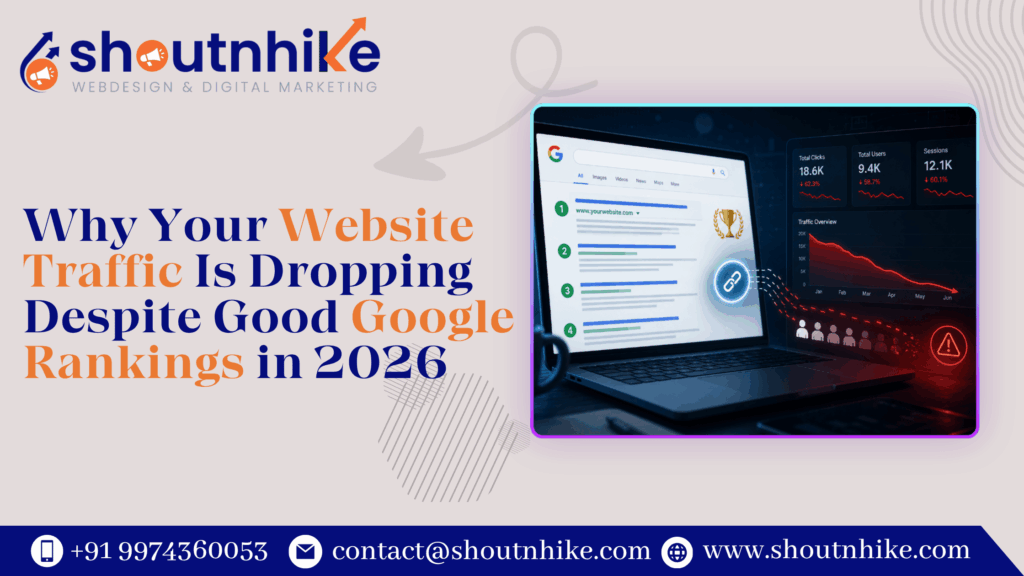
You open Google Search Console on Monday morning. Most of your important keywords are still sitting in positions 2, 3 or 5. Nothing looks alarming.
Then you open GA4.
Organic traffic is down 20%.
This situation is becoming surprisingly common in 2026.
The problem is that good rankings no longer automatically mean good traffic. AI Overviews, AI Mode, local packs, videos, and other search features are changing what users do after entering a query.
At Shoutnhike, we believe businesses should now stop looking at SEO as simply “Where do I rank?” and start asking a better question: “Where did my clicks go?”
Here’s how to find the answer.
Can Rankings Stay Stable While Organic Traffic Drops?
Absolutely.
Rankings, impressions, clicks, and website sessions measure different things.
Imagine your page remains at position #2 for a keyword and receives 10,000 impressions every month. Earlier, 1,000 users clicked your result. Now Google displays an AI-generated answer above your listing and only 500 users click.
Your ranking did not change.
Your traffic dropped by 50%.
That distinction is essential when evaluating SEO performance in 2026.
AI Overviews Are Taking More Informational Clicks
One of the biggest changes is Google’s increasing use of AI-generated answers.
AI Overviews can summarise information from multiple websites directly on the results page. For simple informational searches, users may get enough information without visiting any website.
This particularly affects content such as “What is SEO?”, “How does GST work?” or “What are the benefits of digital marketing?”
Recent industry research has found major CTR reductions when AI Overviews appear, especially for high-ranking informational pages.
That doesn’t mean informational blogging is useless. It means the content needs to offer something the AI summary cannot completely replace.
Think original research, practical templates, expert opinions, calculators, case studies, and first-hand experience.
Google AI Mode Is Changing How People Search
Search is also becoming more conversational.
Instead of searching five separate queries, users can ask Google AI Mode a detailed question and continue the conversation with follow-ups.
For example, somebody researching SEO may ask:
“Which SEO strategy would work for a manufacturing company in Ahmedabad with a ₹50,000 monthly budget?”
That is very different from the old-style query “SEO services Ahmedabad”.
Longer conversational searches mean businesses should create content that answers complete problems rather than targeting isolated keywords.
Zero-Click Searches Are Becoming a Bigger SEO Challenge
Not every search ends with a website visit anymore.
Users can get answers from AI Overviews, featured snippets, Google Business Profiles, Maps, knowledge panels and People Also Ask results.
This creates a simple but important situation:
Your visibility can increase while your traffic decreases.
For local businesses, this is particularly noticeable. A customer may find your phone number through Google Maps and call directly without ever opening your website.
That technically looks like less website traffic—but it may still create revenue.
So traffic alone should not be your final KPI.
Your Organic CTR May Be the Real Problem
When rankings look healthy but clicks fall, check your click-through rate.
Open Google Search Console and compare the same period year-on-year.
If impressions remain similar but clicks and CTR fall, rankings probably aren’t the main problem.
Your search result may simply be receiving less attention.
AI elements, paid ads, videos, shopping results, and richer competitor snippets can all push traditional organic results further down the screen.
Improving your title tag can sometimes create more growth than improving your ranking from position #4 to #3.
Make titles specific, benefit-focused, and closely aligned with search intent.
Search Demand May Have Changed
Sometimes Google isn’t the problem at all.
People may simply be searching less for your keyword.
This happens because of seasonality, new technology, changing terminology and customer behaviour.
Imagine you’re still ranking #1 for a software term whose monthly searches fell from 5,000 to 2,000.
Your SEO performance is technically excellent.
Your market changed.
Compare Search Console impressions with Google Trends before assuming you have an SEO issue.
Search Intent May Have Shifted
Google continuously learns what users expect from a query.
A keyword that previously displayed long-form blogs may now show videos, tools or service pages.
Your article may retain its ranking temporarily but attract fewer clicks because it no longer matches what users want.
Check the current SERP manually.
Ask yourself:
“Would I click my page if I searched this query today?”
If the answer is no, refreshing a few keywords won’t solve the problem. The content format itself may need to change.
AI Platforms Are Becoming Another Discovery Channel
Your customers are no longer researching only through Google.
They may ask ChatGPT, Gemini, or other AI assistants for recommendations, comparisons and explanations.
This makes brand authority increasingly important.
Businesses should publish expert-led content that makes their experience clear, demonstrates real results and provides information worth referencing.
The goal isn’t to stuff pages with “AI SEO” tricks. Google itself continues to emphasise solid technical SEO and unique, valuable, people-first content for generative search.
How to Diagnose Your Traffic Drop
Start with Search Console rather than immediately changing your website.
Compare rankings, impressions, clicks, and CTR.
Then analyse branded and non-branded queries separately. If branded traffic remains healthy but informational traffic falls, AI search features may be contributing.
Next, compare Search Console with GA4. Search Console tells you what happened before the click; GA4 tells you what visitors did after reaching your site.
Google now also provides dedicated reporting for visibility within its generative AI search features, giving businesses another way to understand whether their content is appearing in AI-driven experiences.
How to Recover Traffic Without Chasing Rankings
Start creating content users still have a reason to visit.
Instead of another generic “10 SEO Tips” article, publish something like “SEO Audit of 50 Ahmedabad Business Websites: The 7 Problems We Found Most Often.”
That contains original value.
Prioritise commercial and problem-solving searches alongside informational keywords. Comparison pages, pricing guides, case studies, checklists, and location-focused service content often give users stronger reasons to click.
At Shoutnhike, our approach as a best digital marketing company in Ahmedabad is increasingly centred around visibility, qualified clicks, leads and revenue—not rankings in isolation.
Rankings vs Traffic vs Revenue: What Should You Track?
A #1 ranking feels good, but it does not pay your bills.
In 2026, your SEO dashboard should connect search visibility with organic clicks, CTR, qualified leads, calls, enquiries and revenue.
You may even find traffic dropping while conversions remain stable because lower-value informational clicks are disappearing.
That isn’t necessarily bad SEO.
It may actually mean your traffic is becoming more commercially relevant.
Final Thoughts
SEO isn’t dying. The search journey is changing.
If your website traffic is dropping despite good Google rankings, don’t immediately rewrite every page or start building more backlinks.
First identify what changed.
Was it CTR? Search demand? AI Overviews? Search intent? A new SERP format?
Once you understand where the clicks went, you can build a strategy around where customers are going next.
In 2026, the businesses that win won’t be the ones obsessing over rankings alone.
They’ll be the ones measuring visibility → clicks → enquiries → revenue.
FAQs
Why is my organic traffic falling even though rankings are stable?
AI Overviews, zero-click results, reduced search demand, and changing SERP layouts can reduce clicks without significantly changing your keyword positions.
Are AI Overviews reducing website traffic in 2026?
They can, particularly for informational queries where Google’s AI-generated answer satisfies the user’s question without requiring a website visit.
Does ranking #1 still guarantee high traffic?
No. Ranking #1 remains valuable, but AI answers, ads, videos, local results, and other SERP features can appear above traditional organic results.
How can I increase organic clicks without improving rankings?
Improve your titles, target stronger search intent, refresh outdated content, and publish information users cannot get from a basic AI summary.
Which SEO metrics should businesses track in 2026?
Track rankings alongside impressions, CTR, organic clicks, conversions, qualified leads, revenue, and visibility within AI-driven search experiences.

Chirag Shah
CEO and Founder at Shoutnhike.com
I help client to grow business online with measurable result and swift ROI. I have 20+ years of Digital Marketing Industry experience and I have helped 2000+ business to grow online. I am Google Adwords and Analytics certified professional with practical expertise.
Category:
Digital Marketing
Tags:
AI Overviews SEO Google rankings website traffic drop Zero-Click Searches
 Get a Free Digital Marketing Consultation Get a customised digital marketing strategy to increase your website traffic, leads, and sales.
4.7 Rating from 170+ Google Reviews
 Contact Info
-

Call us
 +91-9974360053
 +44-20709-60062
 +1-908-392-0348
-

Email us
contact@shoutnhike.com -

Skype
shahchiragg
We are Featured in
Digital branding and marketing services built with expert planning and creative execution, helping brands grow stronger in a competitive online industry.