
Table of Contents
- What Does a Relevant Enquiry Mean for a Manufacturing Company?
- How Has the Manufacturing Buyer Journey Changed?
- Manufacturing SEO: Get Found When Buyers Are Searching
- Build Product Pages That Work Like Digital Sales Engineers
- Create Content Engineers and Procurement Teams Actually Need
- Use Google Ads to Capture High-Intent Demand
- Build Industry-Specific Landing Pages
- Use Case Studies to Prove Manufacturing Capability
- Prepare for AI-Assisted Supplier Discovery
- Improve Your RFQ Form to Filter Poor Leads
- Combine SEO, Ads, LinkedIn and Remarketing
- Measure Qualified Enquiries, Not Just Website Traffic
- Final Thoughts
- FAQs
Our Services


Categories
- AI digital marketing agency
- AI Optimization
- Blog Optimization
- Case Study
- Conversion Rate Optimization
- Digital Marketing
- Digital marketing agency
- Digital marketing company
- Digital Marketing Consultant
- digital marketing for manufacturers
- Email Marketing
- Google Ads
- Google Adwords
- Influencer Marketing
- Infographics
- Local Listing
- Local SEO
- Manufacturing
- On-Page SEO
- PPC
- Reputation Management
- Restaurant
- Sales Automation
- SEO
- SEO Services
- SEO Tools
- Social Media Marketing
- Technical SEO
- Technology
- Web Design
Getting 100 enquiries sounds impressive. But what if 70 are job seekers, retail buyers, repair requests, or people asking for products you don’t manufacture?
For manufacturers, more leads don’t necessarily mean more business. Relevant enquiries do.
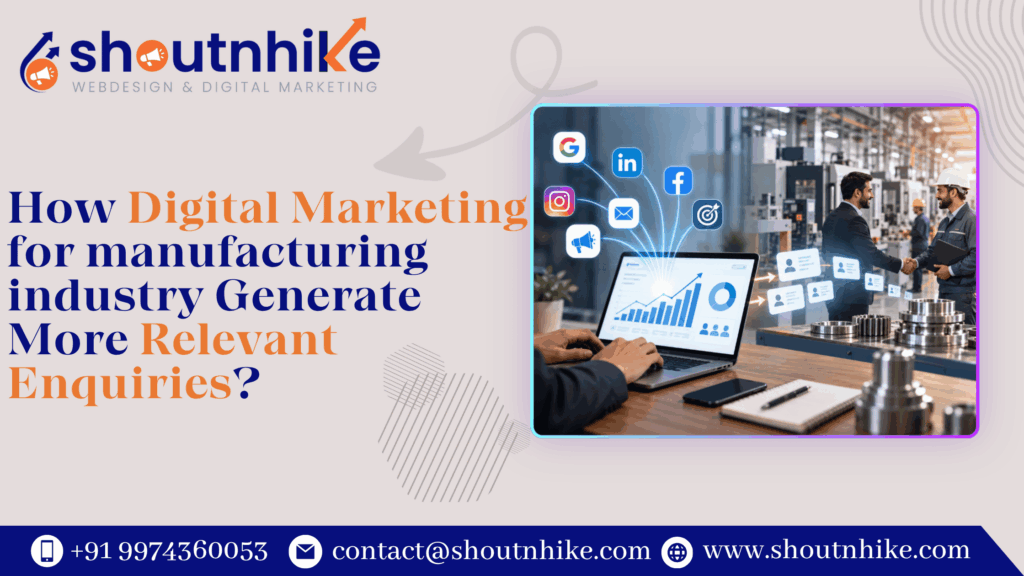
That’s why digital marketing for the manufacturing industry needs a different approach from B2C marketing. Your objective is not simply to increase website traffic. You need to reach procurement managers, engineers, distributors, OEMs, and business owners who have an actual requirement.
Here is how Indian manufacturers can build a more predictable qualified-enquiry pipeline in 2026.
What Does a Relevant Enquiry Mean for a Manufacturing Company?
A relevant enquiry matches what your company can actually supply.
For example:
Generic enquiry: “Please send your product details.”
Qualified enquiry: “We require SS316 components as per the attached drawing, approximately 5,000 units per month. Can you share your manufacturing capability and quotation?”
The second enquiry gives your sales team something meaningful to work with.
A manufacturer should therefore evaluate leads based on product requirement, application, location, quantity, technical specifications, industry and purchase intent.
A useful metric is:
Relevant Enquiry Rate = Qualified Enquiries ÷ Total Enquiries × 100
If you receive 100 enquiries and only 20 are relevant, generating another 100 similar leads isn’t necessarily the solution. Improving enquiry quality should come first.
How Has the Manufacturing Buyer Journey Changed?
Industrial buyers don’t always call a supplier immediately.
A procurement manager may search Google, check several manufacturers, review technical specifications, visit LinkedIn, watch product videos, and increasingly use AI-assisted search before contacting shortlisted suppliers.
This makes your website part of the sales process.
The modern journey often looks like:
Requirement → Online Research → Supplier Discovery → Technical Comparison → Shortlist → RFQ → Evaluation → Order
Your digital presence needs to support every stage.
Manufacturing SEO: Get Found When Buyers Are Searching
SEO is one of the strongest long-term channels because it captures existing demand.
But manufacturing SEO should go deeper than broad terms such as “industrial equipment”.
Suppose you manufacture compressors. A buyer searching:
“10 HP rotary screw air compressor manufacturer India”
is showing much clearer intent than someone searching:
“air compressor”.
Build your SEO strategy around product, specification, material, capacity, application, industry and location keywords.
This is where professional manufacturing digital marketing services can make a difference. Keyword research should prioritise commercial relevance rather than search volume alone.
A keyword with 100 highly relevant monthly searches can sometimes be more commercially valuable than one attracting thousands of unrelated visitors.
Build Product Pages That Work Like Digital Sales Engineers
Many Indian manufacturing websites still have product pages containing one image and a short paragraph.
That isn’t enough for a serious B2B buyer.
Your product page should answer questions before the buyer contacts your sales team:
- What does the product do?
- What specifications are available?
- Which industries use it?
- What materials and capacities are offered?
- Can it be customised?
- What certifications do you have?
- Where do you supply?
- How can the buyer request a quotation?
Add specification tables, applications, technical FAQs, downloadable datasheets, real product images, videos, certifications and a strong Request a Quote CTA.
This also creates clearer information for Google and AI-driven search systems to understand.
Create Content Engineers and Procurement Teams Actually Need
Generic articles such as “Top 10 Benefits of Industrial Machinery” add little value.
Instead, create content around real buying questions.
For example:
“SS304 vs SS316: Which Is Better for Food Processing Equipment?”
“Piston vs Screw Compressor: Which One Is Right for Your Factory?”
“How to Select Filter Press Capacity for Chemical Processing?”
These topics capture long-tail searches while demonstrating technical expertise.
For companies looking for a digital marketing agency for manufacturing companies, this should be an important selection criterion: can the agency understand technical buying intent, or is it simply publishing generic SEO blogs?
Use Google Ads to Capture High-Intent Demand
SEO takes time. Google Ads can place your business in front of buyers already searching for suppliers.
Target terms containing commercial modifiers such as:
manufacturer, supplier, exporter, quotation, price, distributor and OEM.
Equally important is excluding irrelevant traffic.
Negative keywords such as “jobs”, “salary”, “course”, “training”, “second hand” and “repair” can help reduce wasted spend where they don’t match your offering.
Don’t send every campaign to the homepage either. A buyer searching for a specific product should reach a dedicated product or application landing page.
Build Industry-Specific Landing Pages
Your product may serve five industries, but each buyer has different priorities.
Create dedicated pages such as:
- Solutions for Pharmaceutical Manufacturing
- Solutions for Food Processing
- Solutions for Textile Industry
- Solutions for Chemical Plants
Explain the industry’s problem, recommended solution, technical capability, relevant products, and proof of experience.
A good marketing agency for manufacturing should connect campaigns to these high-intent landing pages instead of treating every prospect identically.
Use Case Studies to Prove Manufacturing Capability
B2B buyers want proof.
A strong case study should explain:
Challenge → Requirement → Solution → Implementation → Result
For example, instead of saying, “Our machine improves productivity,” explain what production problem the customer had, what configuration was supplied and what measurable improvement followed.
Only use genuine, verifiable numbers. Real operational evidence is much stronger than promotional claims.
Prepare for AI-Assisted Supplier Discovery
Search is becoming conversational.
Instead of typing:
“industrial mixer manufacturer”
a buyer can ask an AI system:
“Which Indian manufacturers supply customised stainless-steel mixing equipment for pharmaceutical plants?”
To become easier to discover and understand, clearly publish your:
- manufacturing capabilities
- specifications
- certifications
- industries served
- export markets
- applications
- technical expertise
- case studies
Don’t create content only for AI. Create genuinely useful information that buyers and, therefore, search and AI systems have a reason to reference.
Improve Your RFQ Form to Filter Poor Leads
Your form itself can improve enquiry quality.
Instead of collecting only name, email, and phone number, consider asking for:
Company Name | Product Required | Application | Quantity | Location | Specifications | Drawing Upload
Don’t make the form unnecessarily long, but collect enough information for sales to understand whether the opportunity is relevant.
For Indian buyers, WhatsApp can also support quick communication, datasheet sharing, and follow-up. However, enquiries should ultimately enter a CRM rather than remain scattered across personal WhatsApp accounts.
Combine SEO, Ads, LinkedIn and Remarketing
There is rarely one “best” channel in digital marketing for manufacturers industry.
SEO captures long-term search demand. Google Ads captures immediate intent. LinkedIn helps reach technical and procurement decision-makers. Video demonstrates products. Remarketing brings previous visitors back. Email and CRM automation nurture longer sales cycles.
The strongest approach connects these channels.
A buyer may first find your blog on Google, watch your machine demonstration on YouTube, return through remarketing, and finally submit an RFQ.
Measure Qualified Enquiries, Not Just Website Traffic
Manufacturing marketing reports should go beyond:
“Traffic increased 40%.”
Ask what happened after the traffic arrived.
Track:
Qualified RFQs → Quotations → Opportunities → Orders → Revenue
Useful KPIs include:
- relevant enquiry rate
- cost per qualified enquiry
- RFQs generated
- quote-to-order rate
- sales pipeline value
- revenue by marketing channel
For a manufacturer, five qualified enquiries for high-value machinery can be far more useful than 10,000 informational website visits.
Final Thoughts
The purpose of digital marketing for manufacturing industry is not to fill your inbox with random leads. It is to connect your manufacturing capability with companies actively looking for it.
At Shoutnhike, we believe manufacturing marketing should connect SEO, Google Ads, technical content, AI-search visibility, conversion optimisation and lead tracking into one enquiry-generation system.
Start with one simple question:
Are your campaigns generating leads or genuine sales opportunities?
Once you optimise around the second one, digital marketing becomes much easier to connect with actual business growth.
FAQs
Is digital marketing effective for manufacturing companies?
Yes. Digital marketing can help manufacturers reach buyers who are actively researching products, suppliers, technical solutions and manufacturing partners online.
How can manufacturers generate more qualified enquiries?
Target high-intent keywords, create detailed product and industry pages, use technical content, improve RFQ forms and connect marketing data with sales qualification.
Is SEO useful for manufacturing companies?
Yes. SEO helps manufacturers capture buyers searching for specific products, applications, specifications and suppliers. Long-tail technical searches can be particularly valuable because they often reveal stronger intent.
Should manufacturers use Google Ads or LinkedIn?
They serve different purposes. Google Ads is strong for capturing existing search demand, while LinkedIn can help reach specific companies, industries and decision-makers. Many B2B strategies benefit from using both.
What should manufacturers measure in digital marketing?
Focus on qualified enquiries, RFQs, quotations, cost per qualified lead, sales opportunities, pipeline value, orders and revenue rather than relying only on website traffic or raw lead numbers.

Chirag Shah
CEO and Founder at Shoutnhike.com
I help client to grow business online with measurable result and swift ROI. I have 20+ years of Digital Marketing Industry experience and I have helped 2000+ business to grow online. I am Google Adwords and Analytics certified professional with practical expertise.
Category:
digital marketing for manufacturers
Tags:
digital marketing for manufacturing industry manufacturing digital marketing services
 Get a Free Digital Marketing Consultation Get a customised digital marketing strategy to increase your website traffic, leads, and sales.
4.7 Rating from 170+ Google Reviews
 Contact Info
-

Call us
 +91-9974360053
 +44-20709-60062
 +1-908-392-0348
-

Email us
contact@shoutnhike.com -

Skype
shahchiragg
We are Featured in
Digital branding and marketing services built with expert planning and creative execution, helping brands grow stronger in a competitive online industry.