
Table of Contents
- 1. Optimize Your Website for Industrial Buyers
- 2. Use Industrial SEO to Attract High-Intent Buyers
- 3. Run Google Ads for Faster Lead Generation
- 4. Create Technical Content That Answers Buyers’ Questions
- 5. Use LinkedIn to Reach B2B Decision-Makers
- 6. Improve Your Visibility in AI Search
- 7. Build Dedicated Landing Pages for Products and Industries
- 8. Use Email Marketing and CRM Automation
- 9. Optimize Enquiry Forms to Improve Lead Quality
- 10. Measure Results and Improve Your Strategy
- How Shoutnhike Helps Manufacturers Generate Leads
- Conclusion
- Frequently Asked Questions
- 1. What is the best digital marketing strategy for manufacturers?
- 2. How can manufacturers generate more leads online?
- 3. Does SEO help manufacturing companies generate enquiries?
- 4. Are Google Ads effective for manufacturing businesses?
- 5. How can manufacturers attract international customers?
- 6. How can AI search help manufacturers?
- 7. How should manufacturers measure digital marketing ROI?
- 8. How long does digital marketing take to generate manufacturing leads?
Our Services


Categories
- AI digital marketing agency
- AI Optimization
- Blog Optimization
- Case Study
- Conversion Rate Optimization
- Digital Marketing
- Digital marketing agency
- Digital marketing company
- Digital Marketing Consultant
- digital marketing for manufacturers
- Email Marketing
- Google Ads
- Google Adwords
- Influencer Marketing
- Infographics
- Local Listing
- Local SEO
- Manufacturing
- On-Page SEO
- PPC
- Reputation Management
- Restaurant
- Sales Automation
- SEO
- SEO Services
- SEO Tools
- Social Media Marketing
- Technical SEO
- Technology
- Web Design
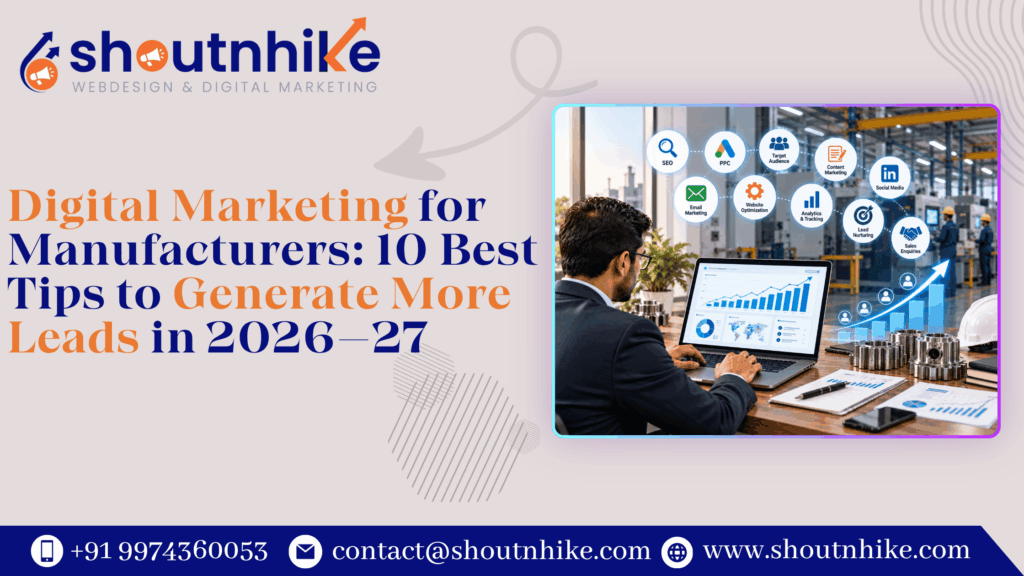
Manufacturing a quality product is one thing. Making sure the right buyers discover it is another.
Whether you manufacture industrial machinery, packaging equipment, pharmaceutical products, engineering components or industrial supplies, your potential customers need to find you when they search for a reliable supplier.
This is where digital marketing for manufacturers makes a difference. It helps businesses improve online visibility, attract relevant buyers, and generate qualified requests for quotations (RFQs).
According to Responsive’s 2025 Inside the B2B Buyer’s Mind report, 90% of surveyed B2B buyers research before their first contact with a vendor. This highlights why manufacturers need a strong online presence before a potential customer reaches their sales team. Source: Responsive.
At Shoutnhike, we believe successful manufacturing marketing should focus on business opportunities, not just website traffic. Here are 10 practical tips to help your business generate more leads.
1. Optimize Your Website for Industrial Buyers
Your website is often the first place a potential buyer looks before contacting you. It should clearly explain what you manufacture, which industries you serve, and why buyers should consider your business.
What to improve:
- Create dedicated product and category pages.
- Include technical specifications, applications, and material details.
- Display relevant certifications and manufacturing capabilities.
- Add product catalogues, datasheets, and demonstration videos.
- Use clear calls to action such as “Request a Quote” and “Submit an RFQ.”
- Make your website mobile-friendly and fast-loading.
For example, an industrial compressor manufacturer should explain compressor types, operating pressure, capacity, applications and available models instead of displaying only product images.
2. Use Industrial SEO to Attract High-Intent Buyers
Search engine optimization (SEO) helps manufacturers appear when potential customers search for their products or solutions.
Instead of targeting broad keywords such as “machine,” focus on specific searches that indicate buyer intent.
Examples include:
- Industrial pump manufacturer in India
- CNC machining company in Ahmedabad
- Pharmaceutical machinery supplier India
- Automatic packaging machine manufacturer
Build your SEO strategy around product pages, industry-specific landing pages, technical blogs and application-based content.
Also, improve internal linking, page titles, meta descriptions, and technical SEO. Track which pages generate relevant enquiries, not just which pages receive the most visitors.
3. Run Google Ads for Faster Lead Generation
SEO takes time to build organic visibility. Google Ads can help manufacturers reach potential customers who are actively searching for products and suppliers.
For better results:
- Create separate campaigns for important product categories.
- Target high-intent commercial keywords.
- Use negative keywords to filter irrelevant searches.
- Direct visitors to relevant product landing pages.
- Track RFQ submissions, calls and qualified enquiries.
- Review cost per qualified lead regularly.
For example, a packaging machinery manufacturer can create a dedicated campaign for buyers searching for automatic filling machine manufacturers instead of sending everyone to the homepage.
Remember, advertising results depend on keyword selection, competition, budget, landing page quality, and follow-up.
4. Create Technical Content That Answers Buyers’ Questions
Industrial buyers often need detailed information before bvxlklop kc jraatoxr. Helpful technical content can answer their questions and establish your company’s expertise.
Consider publishing:
- Product selection guides
- Product comparison articles
- Maintenance and troubleshooting guides
- Industry application blogs
- Technical FAQs
- Customer case studies
For example, a manufacturer could publish “How to Choose the Right Industrial Air Compressor for Your Factory.”
Include insights from your engineers, real product information, and practical examples. AI tools can assist with research and drafting, but technical facts should be checked by knowledgeable team members.
5. Use LinkedIn to Reach B2B Decision-Makers
LinkedIn can help manufacturers connect with procurement managers, engineers, plant heads, distributors, and business owners.
A practical strategy includes:
- Sharing product demonstrations and factory updates
- Publishing technical insights from your team
- Showcasing certifications and completed projects
- Sharing case studies and customer success stories
- Targeting relevant companies and decision-makers through paid campaigns
- Building relationships before approaching prospects with a sales pitch
For manufacturers selling high-value equipment, building credibility over time can be more useful than publishing promotional posts alone.
6. Improve Your Visibility in AI Search
Industrial buyers are increasingly exploring AI-powered search experiences to research suppliers, compare solutions, and understand technical products.
Google’s official guidance explains that traditional SEO fundamentals remain important for AI search features. Google recommends useful, reliable, original content, accessible website information, and strong technical foundations. Source: Google Search Central.
To improve discoverability:
- Explain your products and capabilities clearly.
- Answer specific buyer questions.
- Publish original technical guides and case studies.
- Keep company and product information accurate.
- Use relevant internal links and structured data where appropriate.
- Make important information accessible as text, not only inside images.
These practices support search visibility, but no agency can guarantee that a brand will appear in AI-generated answers.
7. Build Dedicated Landing Pages for Products and Industries
A single page rarely answers every industrial buyer’s needs.
Create focused landing pages for your main products, applications, and industries served.
For example, a manufacturer serving pharmaceutical, food processing and chemical industries may need separate pages explaining the relevant product applications, requirements and benefits for each sector.
Every landing page should include:
- A clear product or solution overview
- Specifications and applications
- Relevant certifications and proof points
- Supporting images or videos
- A clear quotation or enquiry form
Avoid creating thin, repetitive pages just to target more keywords. Each page should provide genuine value to its intended audience.
8. Use Email Marketing and CRM Automation
Manufacturing sales cycles can be lengthy. Some prospects need technical discussions, quotations, and multiple follow-ups before placing an order.
A customer relationship management (CRM) system helps your team organize enquiries and follow up consistently.
Useful workflows include:
- Automatic enquiry acknowledgements
- Product brochure delivery
- Sales follow-up reminders
- Lead assignment to the right salesperson
- Lead status tracking
- Relevant email nurturing
Segment contacts by product interest, industry, and location so that customers receive information relevant to their requirements.
9. Optimize Enquiry Forms to Improve Lead Quality
Getting more form submissions is not enough if most enquiries are irrelevant.
Design forms that collect the information your sales team needs without making the process unnecessarily difficult.
Depending on the product, ask for:
- Company name
- Contact details
- Product requirement
- Industry or application
- Required quantity or capacity
- Delivery location
Add useful options such as “Request a Quote,” “Talk to an Expert,” and “Download Product Catalogue.”
Review the enquiries received and ask your sales team which fields help identify serious buyers. Use this feedback to improve your forms and landing pages.
10. Measure Results and Improve Your Strategy
The final step is understanding which marketing activities contribute to business growth.
Track:
- Organic search visibility
- Website enquiry conversions
- Qualified RFQs
- Cost per qualified lead
- Lead-to-quotation rate
- Quotation-to-order rate
- Sales pipeline and revenue, where measurable
Google Analytics 4 and Google Search Console can help you understand website and search performance. Connecting these insights with CRM data gives a clearer picture of which campaigns generate meaningful business opportunities.
Review results regularly and adjust budgets, keywords, landing pages and follow-up processes based on actual performance.
How Shoutnhike Helps Manufacturers Generate Leads
Shoutnhike helps businesses develop digital marketing strategies that combine SEO, Google Ads, technical content, website optimization and conversion tracking.
For manufacturers, the focus is on making products easier to discover, providing useful information to potential buyers and improving the journey from search to enquiry.
A well-planned strategy connects marketing activity with sales objectives instead of treating traffic, impressions and clicks as the final goal.
Conclusion
Digital marketing for manufacturers works best when every activity supports a clear business objective.
A strong website builds trust. SEO attracts buyers searching for relevant products. Google Ads captures active demand. Technical content answers buyer questions. CRM automation supports consistent follow-up.
Start with your most valuable products, identify your ideal customers, and measure the enquiries that turn into genuine sales opportunities.
With a consistent, data-driven approach, manufacturers can build stronger online visibility and create more opportunities for sustainable B2B growth.
Frequently Asked Questions
1. What is the best digital marketing strategy for manufacturers?
A strong strategy combines industrial SEO, Google Ads, technical content, LinkedIn marketing, conversion optimization and CRM follow-up. The right mix depends on the product, target market, and sales cycle.
2. How can manufacturers generate more leads online?
Manufacturers can generate leads by optimizing product pages, targeting high-intent keywords, running relevant search campaigns, publishing technical content and using clear RFQ forms.
3. Does SEO help manufacturing companies generate enquiries?
Yes. SEO can help manufacturers appear for product, application, and specification-related searches. Results depend on competition, website quality, search demand, and consistent execution.
4. Are Google Ads effective for manufacturing businesses?
Google Ads can help manufacturers reach buyers actively searching for products or suppliers. Campaign performance depends on targeting, advertising budget, landing pages, and lead qualification.
5. How can manufacturers attract international customers?
Manufacturers can use international SEO, country-specific landing pages, export-focused Google Ads, LinkedIn marketing, and technical content designed for overseas buyers.
6. How can AI search help manufacturers?
AI-powered search can help buyers discover and compare suppliers. Manufacturers should publish accurate product information, original technical content, and clear details about their capabilities. Visibility is not guaranteed.
7. How should manufacturers measure digital marketing ROI?
Track qualified enquiries, RFQs, cost per qualified lead, quotation rates, sales pipeline and revenue where measurable. Website traffic alone does not show whether marketing is generating business.
8. How long does digital marketing take to generate manufacturing leads?
Paid advertising can generate visibility soon after launch, while SEO and content marketing usually require sustained effort over several months. Actual timelines depend on competition, the website’s starting condition, and campaign execution.

Chirag Shah
CEO and Founder at Shoutnhike.com
I help client to grow business online with measurable result and swift ROI. I have 20+ years of Digital Marketing Industry experience and I have helped 2000+ business to grow online. I am Google Adwords and Analytics certified professional with practical expertise.
Category:
Manufacturing
Tags:
Digital Marketing for Manufacturers
 Get a Free Digital Marketing Consultation Get a customised digital marketing strategy to increase your website traffic, leads, and sales.
4.7 Rating from 170+ Google Reviews
 Contact Info
-

Call us
 +91-9974360053
 +44-20709-60062
 +1-908-392-0348
-

Email us
contact@shoutnhike.com -

Skype
shahchiragg
We are Featured in
Digital branding and marketing services built with expert planning and creative execution, helping brands grow stronger in a competitive online industry.